If you trust a Waymo with your life, why not an AI clinician?
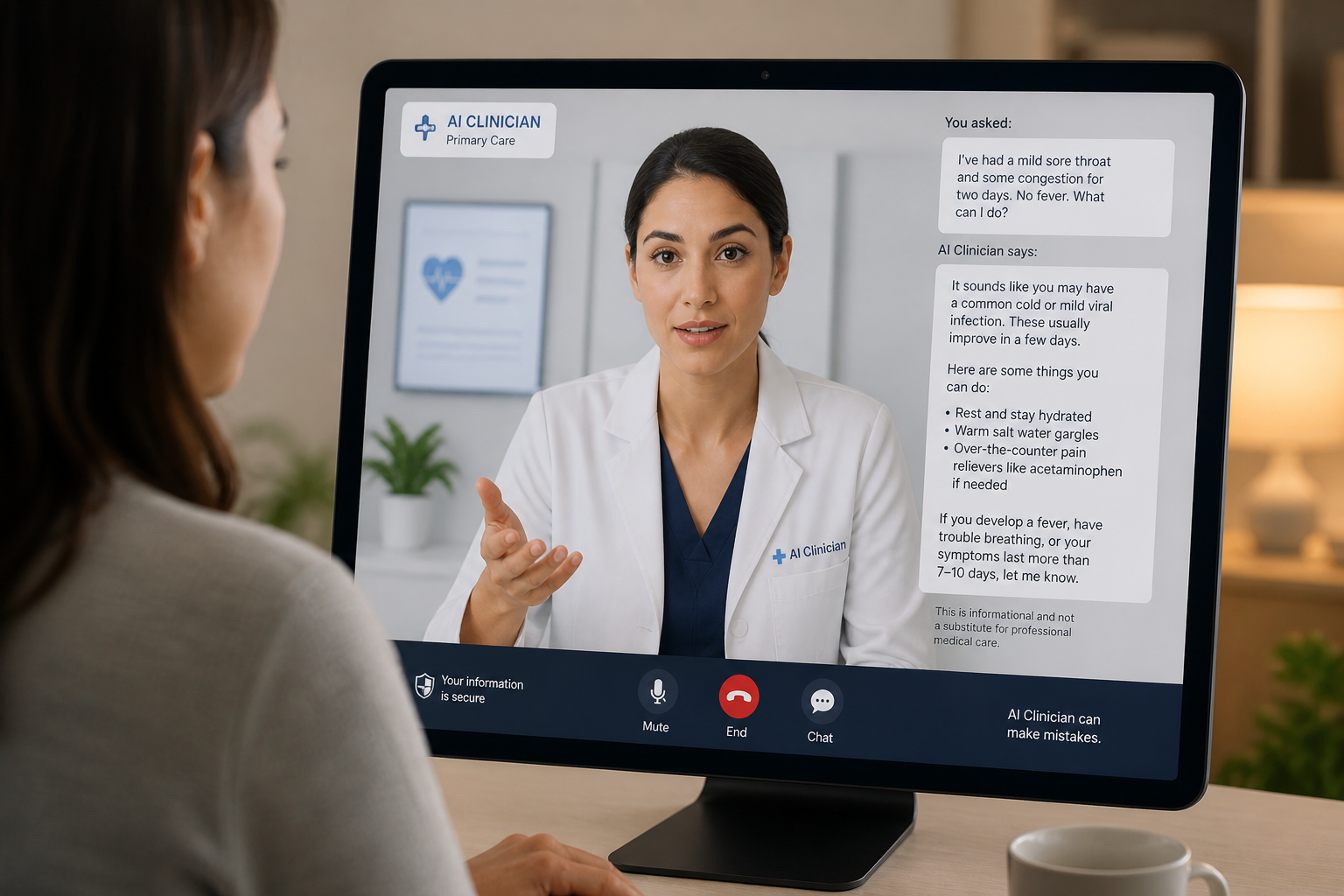
AI-generated conceptual image. Depicted individuals and interactions are fictional.
I recently came across an open letter from members of the medical community arguing that society should move more aggressively toward autonomous vehicles because thousands of lives continue to be lost on our roads every year. The central argument was compelling because it challenged the tendency many of us have to evaluate new technology against a standard of perfection rather than against the reality of the systems we already live with.
The authors pointed out that self-driving vehicles will undoubtedly make mistakes, but if they can ultimately reduce injuries and fatalities compared with human drivers, delaying their implementation also carries consequences. Every year we wait for perfection may be another year in which preventable harm continues at scale.
As I was thinking about that argument, I found myself wondering whether healthcare may be facing a remarkably similar moment.
The standard we apply to technology
Around the same time, there was news involving autonomous vehicles from Waymo after several vehicles reportedly drove into standing water during flooding conditions in Austin and required software modifications to address the issue. The reaction that followed was not particularly surprising. Headlines immediately focused on concerns about safety, questions about readiness, and speculation about whether these systems should be trusted at all. What struck me, however, was how familiar the pattern felt. Whenever a new technology experiences a failure, particularly one involving human safety, the conversation often becomes centered around whether the technology is flawed rather than whether the technology, taken as a whole, produces better outcomes than the alternative.
Human drivers make mistakes every single day. They drive while distracted, exhausted, impaired, or simply inattentive. Human judgment fails with extraordinary regularity, and yet we generally accept that reality because we have lived with it for so long that it feels normal. We don’t expect human drivers to be perfect because we know perfection is impossible (and we’ve all been on the road and seen it first hand; case closed). Instead, we continually seek ways to reduce risk, improve safety, and create better systems.
Increasingly, evidence suggests that autonomous driving systems may produce better aggregate outcomes than humans, even while continuing to make occasional mistakes of their own. The important question is whether they fail less often and whether the overall benefits substantially outweigh the risks.
It may be exactly the conversation healthcare needs to have regarding AI clinicians.
AI is competing with reality, not perfection
Much of the discussion around AI in medicine seems to begin with the assumption that AI must meet a nearly impossible standard before we are willing to trust it. I frequently hear versions of the argument that every AI-generated clinical recommendation must include a human decision-maker at every stage of the process. While I understand the instinct behind that thinking, I wonder whether it reflects a deeper discomfort with technology rather than an objective assessment of outcomes.
These concerns arise as we learn how to embrace new technology and find where to apply it in our daily lives.
Healthcare itself is hardly a perfect system. Physicians misdiagnose patients. Medication errors occur. Patients frequently fall through cracks in the system. Access remains limited in many communities, and there are countless individuals who delay or completely avoid care because appointments are unavailable, costs are prohibitive, or providers simply do not exist where they live. We sometimes talk about AI as though it is competing against some idealized version of healthcare, but that’s not the comparison we should be making. AI is competing against the healthcare system that exists today, with all of its imperfections, inefficiencies, and limitations.
The Triple Aim opportunity
What makes AI particularly interesting to me is that it has the potential to improve the three objectives that have long been described by the Institute for Healthcare Improvement as the “Triple Aim:” improving the patient experience, improving population health, and reducing per capita cost. Imagine a world where patients who struggle accessing care can receive hypertension screenings, behavioral health assessments, medication evaluations, and early interventions through AI-enabled systems. Imagine care becoming more affordable and more available to populations that historically have had difficulty accessing services. Imagine identifying patients earlier and directing them toward interventions before problems become more serious and more costly.
As you may know if you’ve been hanging out with me for some time, I’m bullish on AI. However, there will be instances where AI clinicians make mistakes. I also believe some of those mistakes will become highly publicized. Whenever a technology carries the potential to influence human lives, failures inevitably become amplified. To level set, we have to acknowledge (much to our chagrin) that physicians make mistakes and our healthcare system produces adverse outcomes, and at times, on a significant scale. The issue is not whether AI will occasionally fail. The issue is whether preventing those occasional failures is worth delaying technologies that may improve care for millions of people.
But what if it was your son or daughter in that autonomous car when it failed? What if it was your son or daughter receiving clinical instructions from an AI doc? How would you feel about it then?
Redefining human oversight
I sometimes wonder whether we unintentionally create barriers to innovation because we expect new technologies to achieve standards that we never apply to—but perhaps expect from—human beings. We appear willing to tolerate a certain amount of imperfection when those imperfections are familiar to us, but we become considerably less forgiving when technology is involved. In many cases, perfection becomes the requirement for progress, and perfection has always been the enemy of meaningful improvement.
None of this suggests that we should blindly hand medicine over to untested systems or remove thoughtful oversight. Transparent development matters. Rigorous research matters. Pilot programs matter. Responsible regulatory frameworks matter. The kinds of AI clinician pilots currently emerging in states like Utah (Doctronic) are exactly the kinds of efforts we should be encouraging because they allow us to evaluate these systems in controlled and measurable ways. And even a pilot study such as Utah’s has stirred controversy, where the Utah Medical Licensing Board called for an immediate suspension of the program. But the state ruled against the Board and is continuing the 12-month program.
What I am suggesting is that we may need to broaden our thinking around what oversight actually means. Human oversight does not necessarily require a human to replicate every single action an AI system takes. Healthcare already includes multiple safeguards throughout the process. Pharmacists review medications. Clinical pathways guide decision-making. Escalation systems identify higher-risk patients. Referral networks ensure that patients requiring additional expertise reach appropriate providers. Oversight can exist without eliminating the efficiency that makes AI valuable in the first place.
Healthcare's Waymo moment
Ironically, AI may ultimately make physicians busier rather than less necessary because these systems may identify more patients who need intervention and care. The challenge for healthcare leaders may not be deciding whether AI belongs in medicine, but rather determining how to thoughtfully integrate technology and human expertise in ways that improve outcomes for everyone involved.
The fear-based conclusion is that displaced medical physicians and pharmacists will be flipping burgers (until they are flipped by robots), when in reality, AI implementations are creating more opportunities to serve in all sectors, not just healthcare.
As leaders think about what comes next, we could remember that we’re already placing our trust in AI systems that influence life-and-death decisions every day. If we are becoming comfortable getting into autonomous vehicles and allowing technology to navigate crowded streets on our behalf, perhaps we should also become more open to the idea of having conversations with AI clinicians. I am not arguing that these systems will be perfect because they will not be. I am positing that they may ultimately help us create a healthcare system that is more accessible, more efficient, and more effective than the one we have today.